
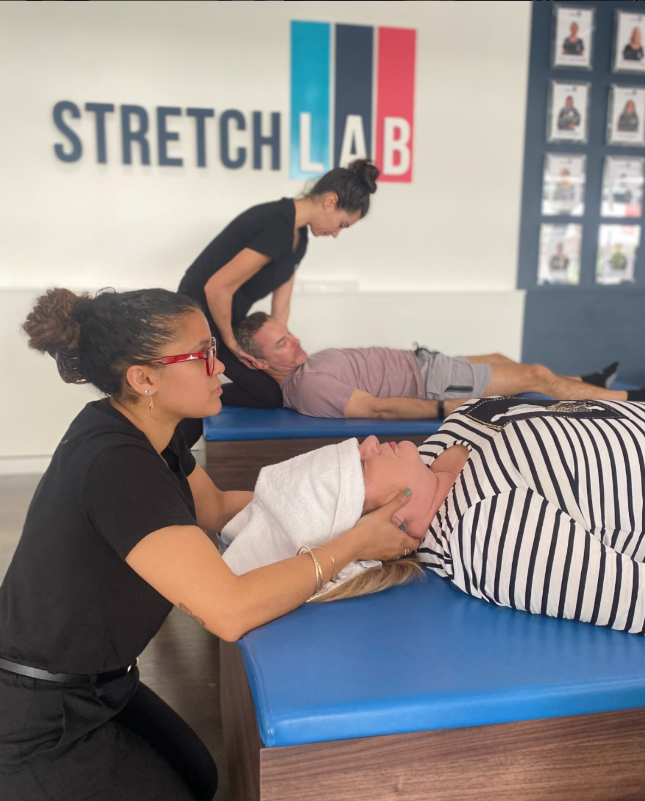
Why assisted stretching feels less like another wellness task, and more like genuine relief.
-Taryn Gray
There are certain things you expect to feel good afterwards.
A massage is one of them. A stretch session? I wasn’t entirely convinced.
That changed very quickly after my first visit to StretchLab Australia.
I had booked in for an assisted stretch session with Flexologist Gia, expecting something somewhere
between mobility work and guided stretching.
What I didn’t expect was to walk out feeling lighter, looser and genuinely better in my body
than I do after most full-body massages.
The experience begins with what StretchLab calls a MAPS assessment, a 3D body scan that
measures mobility, activation, posture, and symmetry.
After completing a few simple overhead squats, the scan visually maps where the body is compensating,
where posture is out of balance, and which muscles are overworking to support others.
Seeing it mapped out so clearly was surprisingly confronting.
Tiny shifts and patterns you don’t consciously notice every day suddenly become obvious.
It also immediately changed my perception of stretching itself.
This wasn’t a generic “touch your toes and hold for 30 seconds” kind of experience.
The session was completely tailored to what my body specifically needed.
A More Personal Approach to Stretching
Gia was incredibly knowledgeable, not just about flexibility, but about how the body functions as an interconnected system.
Throughout the session she explained how certain tight areas were likely creating compensation
elsewhere, particularly through the hips, shoulders and lower back.
It felt far more personalised and intelligent than I had expected.
The actual assisted stretching is done on a large padded bench while the Flexologist moves and stabilises
your body through a series of stretches you simply could not achieve properly on your own.
Some were deep, some surprisingly relaxing, but what stood out most was how I felt afterwards.
My body felt longer. Less restricted. I realised how much low-level tension I had normalised.
Like many people, I spend long periods sitting at a computer, carrying stress through my shoulders and
unknowingly bracing through my body. The session created a kind of physical exhale I didn’t realise I needed.
Related: Choose Stretching over Stressing: The Power of Posture
Why Assisted Stretching Feels Different
What stayed with me most was how calming it felt on my nervous system.
There’s something about being supported into stretches, rather than forcing your body through them
yourself, that allows you to relax more deeply.
It felt restorative rather than performative.
Less about chasing flexibility goals and more about helping the body function more efficiently.
Related: How Yoga Integrates Body, Mind and Spirit
Sustainable Care Over Constant Optimisation
In many ways, it reflects a broader shift happening within wellness right now.
Moving away from extreme optimisation and towards maintenance, regulation and sustainable care.
Would I replace strength training, movement or regular exercise with assisted stretching alone?
Of course not. But that’s not really the point.
What makes assisted stretching so appealing is that it offers exceptional benefits without adding more
effort, intensity or “wellness load” to an already full life.
It supports the body rather than demanding more from it.
You feel amazing during the session, more open, relaxed and physically at ease, but the real value comes through consistency.
Regular sessions can help improve mobility, reduce tension, support posture and keep the body functioning more freely day to day.
In a wellness world that often asks us to do more, push harder and optimise everything, assisted stretching feels refreshingly restorative.
Simple, supportive and genuinely beneficial.
Editor’s note: StretchLab provided a complimentary session for review. All thoughts and opinions expressed are my own.
Originally featured in CENTRED Magazine Issue 11.
Explore the full issue for more conversations on movement, recovery and everyday wellbeing.